Connected Chemistry 2019 Curricular Unit
Table of Contents
Project description
Connected Chemistry 2019 (CC'19) is a six-lesson high school chemistry unit on ideal gas laws that I developed as part of the CT-STEM Research Project, with the help of fellow PhD student Nick LaGrassa and two in-service chemistry teachers. While designing the unit, I built on a long lineage of constructionist Connected Chemistry units, and attempted to use the CT-STEM taxonomy as my guiding framework.
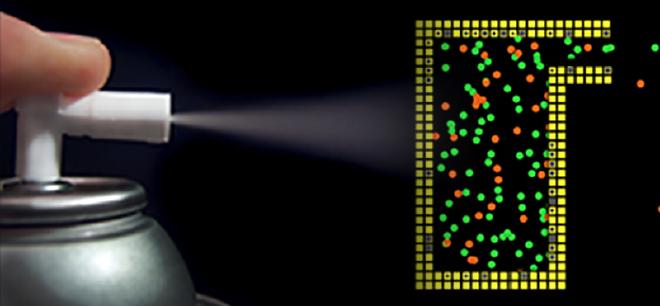
My motivation in creating this unit was that students should not simply memorize the relationships between pressure, temperature, volume, and the number of particles — they should discover those relationships by creating and running experiments with agent-based models of gas particles. The unit starts by asking students to sketch their intuitive ideas about what happens inside an air duster can. From there, they program their own agent-based simulations using phenomenological programming, run experiments with their models to generate and analyze data to derive the gas laws from their own findings — all within a unit structure that also includes hands-on lab experiments, small and large group discussions, and metacognition activities.
Publications
Aslan, U., Horn, M., & Wilensky, U. (2024). Why are some students “not into” computational thinking activities embedded within high school science units? Key takeaways from a microethnographic discourse analysis study. Science Education, 108, 929–956. https://doi.org/10.1002/sce.21850
Aslan, U., Wu, S. P., Horn, M., & Wilensky, U. (2021). Connecting the “chemistry triplet” through co-designing computational models with teachers: A case study on calorimetry. Paper presented at American Educational Research Association (AERA) 2021 Annual Meeting. https://doi.org/10.3102/1686353
Aslan, U., LaGrassa, N., Horn, M., & Wilensky, U. (2020). Phenomenological programming: A novel approach to designing domain-specific programming environments for science learning. In Proceedings of the Interaction Design and Children Conference (IDC) 2020 (pp. 299–310). https://doi.org/10.1145/3392063.3394428
Aslan, U., LaGrassa, N., Horn, M., & Wilensky, U. (2020). Putting the taxonomy into practice: Investigating students’ learning of chemistry with integrated computational thinking activities. Paper accepted to American Educational Research Association (AERA) 2020 Annual Meeting. https://doi.org/10.3102/1584908
Aslan, U., LaGrassa, N., Horn, M., & Wilensky, U. (2020). Code-first learning environments for science education: a design experiment on kinetic molecular theory. In Proceedings of the Constructionism Conference 2020 (pp. 206–219). https://par.nsf.gov/biblio/10203594